

Private blog networks (PBNs): cost, detection and whether one ever makes sense
A private blog network is a group of sites one operator controls and uses to link to their own money sites. It is expensive to run well, usually ends in the whole network being devalued, and only fits sites the owner can afford to lose.
In short
- A PBN is a set of sites controlled by one operator, usually built on expired domains that already have backlinks, and used to link to money sites.
- A realistic build costs $150 to $600 per site, then $10 to $40 a month per site for hosting, content and maintenance. These are practitioner estimates.
- The risk is R4. The usual outcome is that the whole network is devalued at once: the links still exist and pass nothing.
- The link graph is the biggest footprint, because every site in the network links to the same small set of money sites.
- Public PBN links sell for $1 to $5 each in bundles, according to Respona's 2026 guide, and are the fastest to be burned.
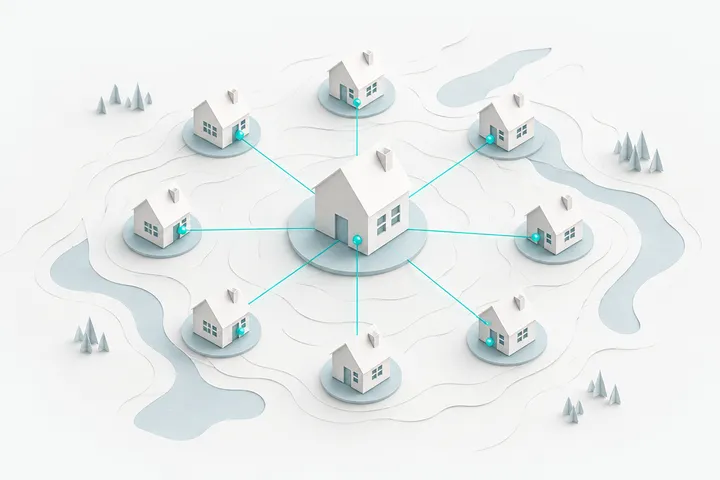
A private blog network, or PBN, is a group of websites controlled by one operator and used to link to that operator’s money sites. Most are built on expired domains that still have backlinks from their earlier life. The risk is R4: a clear policy violation with a realistic chance of the whole network being neutralised.
This page explains what a network is, what it costs, how it gets found, and how to decide whether one could ever be worth it. It is an analysis, not a build guide.
The four kinds of network
| Type | Who gets links | What tends to happen |
|---|---|---|
| Private | The operator’s own sites only | Lasts longest, costs the most per link |
| Semi-private | A few clients | Footprint grows with each client |
| Public | Anyone who pays | Burned fastest |
| Real-site network | Varies | Sites with real content and traffic, hard to tell apart from a small media group |
The last type matters. The closer a network gets to a set of real sites with real readers, the less it looks like a network and the more it costs. At that point the operator is running a small publishing company.
Why people build them
Control. The operator picks the page, the anchor and the timing, pays no publisher, and cannot have the link removed by someone else.
Scarcity is the other reason. In markets where most publishers refuse the topic, such as gambling, adult, pharma and loans, the supply of ordinary placements is small and shared between competitors. A network is supply nobody else can buy.
What a network costs
Almost every figure here is an estimate or comes from a single source. There is no measured dataset for PBN costs.
| Item | Cost | Basis |
|---|---|---|
| Domain, usable | $50 to $500 | Practitioner estimate |
| Domain, strong | $1,000 to $10,000 or more | Practitioner estimate |
| Full build per site: domain, content, setup | $150 to $600 | Practitioner estimate |
| Upkeep per site: hosting, content, maintenance | $10 to $40 a month | Practitioner estimate |
| Fully built unit | “Four figures” | ICODA, one industry source |
Take the build and upkeep estimates together. Twenty sites cost $3,000 to $12,000 to build. Running them for twelve months adds $2,400 to $9,600. That is before the operator’s own time, and before replacing sites that drop out of the index.
Buying links on someone else’s network is cheaper and worse.
| What is sold | Reported price | Confidence |
|---|---|---|
| Public PBN links, in bundles | $1 to $5 each | Respona, 2026 |
| Semi-private homepage links | $30 to $150 each, rented or permanent | Low |
| Rented homepage links in high-risk markets | $10 to $100 per link per month | Low |
The domain supply is the same one described under expired domains, and the same history checks apply.
How networks get detected
A network is only useful while its sites look unrelated. Each thing they share is a footprint.
Infrastructure. Shared IP addresses, nameservers, hosting companies, registrars and registration dates.
Software and accounts. The same themes and plugins. The same analytics, advertising or tag manager IDs. The same Search Console account.
Site shape. No about page, no named author, 5 to 30 posts, and a commercial link in every post.
Outbound links. Unrelated niches side by side: a marketing blog that links to crypto, casino and CBD sites.
History. A topic switch between the archived version of the domain and the current one.
Blocked crawlers. Many networks block SEO tools so competitors cannot see their links. That hides nothing from Google, and the block is itself visible to anyone who checks.
The link graph. This is the largest footprint. Every site in the network links to the same small set of money sites. Google’s spam systems model relationships between sites, and no amount of hosting variety changes who links to whom.
Growth shape. A money site whose referring domains jump suddenly, then stop.
These are the same signs you should look for when a seller offers “private” links, or when an agency will not say where its links come from. How to vet a publisher turns them into a checklist.
What happens when one is found
The usual outcome is not a penalty. The whole network is devalued at once: the links stay live and pass nothing. Nobody is told. The operator finds out when rankings slide.
Manual actions for unnatural links also happen, and networks can be removed from the index in batches. Google said with its March 2026 spam update that once the effect of spam links is removed, the ranking benefit is lost and cannot be regained by cleaning up. Google link penalties and recovery covers both routes.
How long a network lasts is uncertain. ICODA gives an average of about three years for a well-kept network. Our research suggests modelling 6 to 18 months, and far less where footprints are sloppy.
A decision framework
Work through these in order. A “no” at any step ends the question.
- Can the money site be lost? If it is a brand, a client’s site or a licensed operator, do not use a PBN.
- Does every competitor in the top ten use them? In casino, payday, adult and pharma results that is often the case. There a network is a cost of entry, on sites built to be replaced.
- Can you afford to do it properly? That means real content, real hosting variety, and fewer than one money-site link per ten posts. If not, public PBN links are money wasted.
- Does the sum work? Monthly revenue from the rankings must exceed the network’s cost divided by the months it is likely to survive. Use 6 to 18 months.
- Is everything isolated? No shared accounts, no links between network sites, and separate money sites per network.
Many groups in high-risk markets run what is called a barbell: the licensed brand domain stays clean, and affiliate or satellite sites take the risk at arm’s length. Three caveats apply. Regulators increasingly hold licence holders responsible for their affiliates. Google can connect assets through hosting, analytics, link and redirect patterns. And the disposable side has no residual value, so its real cost includes rebuilding it again and again.
The rule we would publish: never apply a tactic to an asset whose loss you cannot afford, and never assume a wall between assets that share footprints.
Who uses them
Churn and burn affiliates, and operators in high-risk verticals. The iGaming hub describes that market. For them a domain is a consumable.
When not to use one
For nearly everyone else, the answer at step one is no. A network that costs several thousand dollars a year will pay for a meaningful number of vetted placements or a digital PR campaign, and those links belong to a site you get to keep. If an agency’s links turn out to come from sites it owns, ask for the method to be disclosed per link, in writing.
Common questions
What is a PBN in SEO?
A private blog network is a group of websites owned or controlled by one operator and used to place links to that operator's own sites or to clients. Most are built on expired domains that still have backlinks.
Do PBNs still work?
Opinion is split. In uSERP's September 2026 survey, 16.4 percent of senior SEOs called PBNs a dying tactic, while forum reports in 2026 still claim results from carefully built networks. Those reports are anecdotal and low confidence.
How much does a PBN cost?
Practitioner estimates put a quality build at $150 to $600 per site, plus $10 to $40 a month per site to run. One industry source, ICODA, describes fully built units as costing four figures each.
Can Google detect a PBN?
Often, yes. Shared hosting, registrars, themes and analytics accounts give networks away, and so does the pattern of many sites linking to the same money sites. The usual result is that the network's links stop counting.
Are PBN links from sellers worth buying?
Public PBN links at $1 to $5 each are sold to anyone, so the networks are burned fastest. Our research treats them as wasted money on a site you care about.
Vendors to look at


- Spamzilla
Expired domain finder SaaS with spam scoring
- DomCop
Expired and expiring domain database (3.5M names, 9 marketplaces) with Moz/Majestic/Ahrefs metrics and personal crawler
- ExpiredDomains.net
Free expired/deleted domain search engine across 676 TLDs
 GoDaddy Auctions
Expired and aftermarket domain auctions (part of GoDaddy)