Tiered link building: what it is, what it costs and how it gets caught
Tiered link building means building links to the pages that link to you. The clean version is promoting coverage you earned. The spam version points automated links at paid placements, falls under Google's link spam policy, and we rate the evidence that it still works as low.
In short
- Tier 1 links point at your site, tier 2 links point at the pages that link to you, and tier 3 links point at tier 2.
- Operators use tiers for two reasons. They want the linking page indexed, and they want it to pass more authority.
- Automated tier 2 and tier 3 links fall under "automated programs or services creating links" in Google's link spam policy.
- The first risk lands on the tier 1 publisher, who may remove your link when its page attracts thousands of spam links.
- Analysts read the 2024 leaked Google documentation as describing measurement of sudden spikes of similar anchors, which is the pattern a tier blast creates.
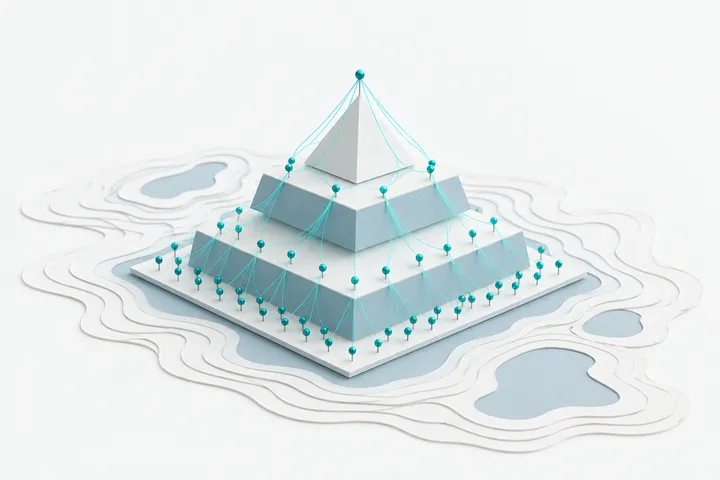
Tiered link building is the practice of building links to the pages that link to you. Your own backlinks are tier 1. Links pointing at those pages are tier 2, and links pointing at tier 2 are tier 3. The idea is that a linking page with links of its own is stronger, so the link it gives you is worth more.
There is a clean version and a spam version, and they share only the name.
What the tiers are
| Tier | Points at | Clean version | Spam version |
|---|---|---|---|
| Tier 1 | Your site | Press coverage, guest articles, partner pages | Paid placements, private blog network posts |
| Tier 2 | The tier 1 pages | Sharing the coverage, linking to it from your newsroom, newsletter or a later guest article | Web 2.0 blogs, public blog networks, bought posts aimed at the tier 1 URL |
| Tier 3 | The tier 2 pages | Rarely exists | Bulk automated links: forum profiles, comments, guestbooks |
The clean version is ordinary promotion. If a newspaper covers your study, you share the article and link to it from your press page. That helps the article get crawled, and it is the coverage working as intended. The rest of this lesson is about the spam version, because that is what people usually mean by the term.
Why operators use tiers
Indexing. A link can only count if Google crawls the page it sits on, and in practice only if that page is indexed. Paid placements often sit on weak pages that nobody links to, deep in a site’s archive. Operators point tier 2 links at them to get them crawled. No reliable public study says what share of bought links sit on unindexed pages, and vendor claims vary widely.
Page-level strength. PageRank passes from page to page, so a linking page with its own links has more to pass. The documentation leaked from Google in 2024 also describes a quality bucket for anchors tied to the index tier of the linking page. Analysts infer from this that a link on a low-tier page counts for little. That is a reading of field names, not a confirmed ranking rule. What the leak and court documents say about links sets out what is confirmed and what is inferred.
Distance. Operators also believe that keeping the spam one step away from the money site keeps the money site safe. As the detection section shows, that belief rests on weak ground.
According to the practitioner sources we reviewed, the main real-world use in 2026 is narrow: getting tier 1 pages indexed, and adding strength to paid placements on weak pages. The people who do it are mostly affiliates and operators in high-risk markets.
What it costs
There is no verifiable 2026 price data for most of this market, so read every figure below as reported, not measured.
| Item | Reported price | How solid |
|---|---|---|
| Tier 2 packages | About $20 to $200 per tier 1 URL | Low. Practitioner and forum sources |
| Web 2.0 packages | About $5 to $50 | Low. Practitioner sources |
| Public blog network posts | $1 to $5 per link in bundles | Medium. Reported by Respona |
| GSA Search Engine Ranker licence | $127, one payment | Vendor price, checked October 2026 |
| Running automation | About $50 to $300 a month for proxies, captcha solving, servers and target lists | Rule of thumb |
The cash cost is small next to the tier 1 placements themselves, which is why the tactic appeals. A paid guest post that costs several hundred dollars looks like a waste if the page never gets indexed, and a $50 package that promises to fix that looks cheap.
The hidden cost is churn. Automated links are placed on platforms that clean up or disappear, and practitioner sources describe more than 90% of such links being lost within months. Treat that as an observation from operators, not a study. See public PBNs and automation for the full cost and risk card.
The risks
It breaks the policy. Google’s link spam policy lists “automated programs or services creating links” as link spam. The tier does not change that. We rate the clean version as low risk and spam tiers as moderate risk on our scale.
The publisher carries the first hit. The spam points at the publisher’s page, not at yours. A guest post URL that suddenly has thousands of spam referring domains is easy for the site owner to spot in any backlink tool. The publisher may remove your link, and is unlikely to welcome another order.
The benefit can vanish. Google’s default since Penguin 4.0 is reported to be to ignore spam links. If the tier 2 links are ignored, you paid for nothing. If the tier 1 placement is itself judged to be a paid link, the whole chain is worth nothing, and Google’s note with the March 2026 spam update says that benefit, once removed, cannot be regained.
How it gets detected
Google does not publish how it detects tiers. What follows is drawn from documented footprints and from analyst readings of the leak.
- Platform footprints. Automation tools post to the same kinds of sites: forum profiles, guestbooks, comment sections and free blog platforms. The result is thousands of links on foreign-language pages unrelated to the topic.
- Spikes. A tier 1 URL goes from zero to thousands of referring domains in days. Analysts read the leaked documentation as describing measurement of sudden bursts of similar anchors, with anchors inside the burst open to demotion. The link velocity lesson covers this in detail.
- Thin hosts. Web 2.0 tiers sit on brand-new subdomains with one to five posts, spun or generated text, and every link going to one target.
- The link graph. With its December 2022 link spam update, Google is reported to have said its SpamBrain system detects both sites that buy links and sites used to pass links on. A group of unrelated pages that all receive the same kind of spam, and all link to the same commercial site, forms a pattern in that graph. This is the same exposure that undoes a private blog network.
- Link loss. Links that appear in bulk and then die in bulk leave their own trace.
You can run the first two checks yourself. Open any tier 1 URL in a backlink tool and look at its referring domains over time. The backlink tools comparison lists tools that show this.
Does it work?
The honest answer is that nobody outside Google can show it does, reliably, in 2026. The theory is sound: a stronger page passes more. The practice depends on spam links counting, and Google’s systems are designed to make them not count. Our research rates confidence that spam tiers work reliably as low. Forum reports of success exist, but they are anecdotes and cannot be verified.
When not to use it
Do not point automated links at placements on sites you want to work with again, at earned press coverage, or at anything linked to a brand or client site you cannot afford to lose. If a placement will not get indexed without spam behind it, the better conclusion is that the placement was not worth buying. The lesson on how to vet a publisher includes the indexing checks to run before you pay.
For where tiers sit among other methods, see white hat, grey hat and black hat link building, and the glossary for any term used here.
Common questions
What is tiered link building?
It is building links in layers. Tier 1 links point at your own site. Tier 2 links point at the pages that carry those tier 1 links, to strengthen them and get them indexed. Tier 3 links point at tier 2.
Is tiered link building safe?
Promoting coverage you earned, by sharing it and linking to it from your own channels, is within Google's guidelines. Pointing automated or bought links at your placements breaks the link spam policy, and the publisher who hosts your link carries the first risk.
Does tiered link building still work in 2026?
The theory holds, since a stronger linking page passes more. Whether spam tiers produce that strength reliably is doubtful. We rate confidence that they work reliably in 2026 as low, because Google's systems are built to ignore exactly these links.
What are tier 2 backlinks?
Links that point at a page linking to you instead of at your own site. A social post sharing an article that mentions you is a tier 2 link. So is a blast of forum profile links aimed at a guest post.
How much do tier 2 links cost?
No reliable 2026 price data exists. Seller listings are reported at about $20 to $200 per tier 1 URL, which is a low-confidence figure from practitioner sources.