

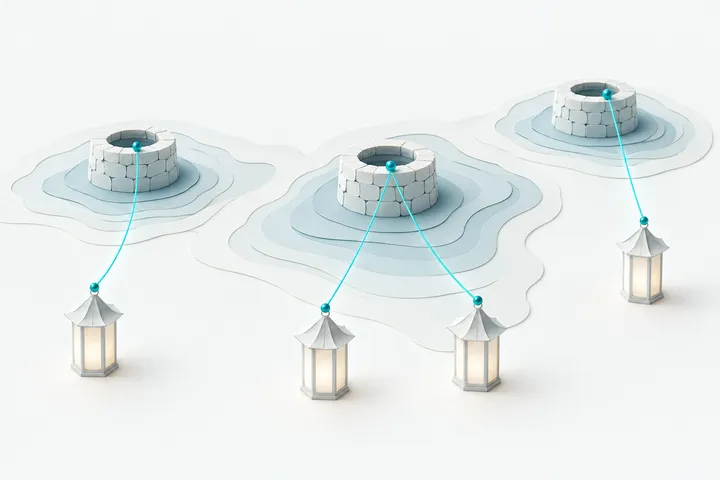
Which search index does each AI assistant use?
Google's AI features use Google's index, Copilot uses Bing, Perplexity uses its own, ChatGPT uses third-party providers plus its own crawler, and Claude is reported to use Brave. Each has its own crawler rules, so being indexed in Google alone does not make you retrievable everywhere.
In short
- Google's documentation says AI Overviews and AI Mode need nothing beyond a page being indexed and eligible for a snippet in Google Search.
- OpenAI's documentation says sites that disallow OAI-SearchBot "will not be shown in ChatGPT search answers", while GPTBot only governs training.
- Microsoft's February 2026 AI Performance report covers Copilot, AI summaries in Bing and some partner products, which ties Copilot visibility to the Bing index.
- Claude's web search is reported to run on Brave Search, based on one analysis of Anthropic's supplier list, which Anthropic's product documentation does not confirm.
- In Ahrefs' September 2025 study of short keywords, Perplexity matched Google's top 10 for 65% of its citations, against 10% for ChatGPT.
Each assistant searches a different copy of the web. Google’s AI features use Google’s index. Copilot uses Bing’s. Perplexity built its own. ChatGPT combines third-party search providers with its own crawler. Claude is reported to use Brave Search. If your pages are missing from one of those indexes, that assistant cannot cite you, whatever your Google rankings are.
How AI search chooses sources has a short version of this table. This lesson goes through each assistant: what is officially documented, what is only reported, which crawler to allow and what to check.
The summary
| Assistant | Index it retrieves from | Search crawler to allow | How sure |
|---|---|---|---|
| Google AI Overviews and AI Mode | Google’s index | Googlebot | High. Google documentation |
| Gemini | Google Search, through a grounding feature | Googlebot | High for the API, lower for the consumer app |
| ChatGPT search | Third-party providers plus OpenAI’s own crawl | OAI-SearchBot, and Bingbot | High for the official part, medium for the Google report |
| Microsoft Copilot | Bing’s index | Bingbot | Medium to high. Microsoft’s own reporting ties the two together |
| Perplexity | Its own index | PerplexityBot | High. Perplexity documentation |
| Claude | Brave Search, reportedly | Brave’s crawler, and Claude’s own agents | Medium. One secondary analysis |
Google AI Overviews, AI Mode and Gemini
Google’s documentation on AI features says there are no extra requirements. A page needs to be indexed and eligible to show with a snippet in Google Search. It also says you do not need new machine-readable files, AI text files or markup. Google’s March 2025 announcement of AI Mode also names the Knowledge Graph and shopping data as sources.
For Gemini, Google’s API documentation describes “grounding with Google Search”: the model writes search queries, runs them on Google Search and returns an answer with source annotations. That is confirmed for developers. That the consumer Gemini app works the same way is widely assumed, and we have not verified it in Google’s documentation.
What to check: ordinary Google indexing in Search Console. Nothing else is needed.
ChatGPT search
OpenAI’s crawler documentation, read on 4 October 2026, lists separate agents with separate jobs.
- OAI-SearchBot is used to surface websites in ChatGPT’s search features. Sites that disallow it “will not be shown in ChatGPT search answers”.
- GPTBot collects content for training models. Disallowing it has no effect on search answers.
- ChatGPT-User fetches a page when a user’s request needs it. OpenAI says robots.txt rules may not apply, because the action is started by a user.
On where results come from, OpenAI says it uses third-party search providers as well as its own crawl. Bing was the launch partner. The Information reported in August 2025 that OpenAI also used Google results obtained through the scraping service SerpApi, and Google sued SerpApi on 19 December 2025. OpenAI’s documentation does not confirm the Google part, so treat it as a report.
What to check: that robots.txt allows OAI-SearchBot, and that your key pages are indexed in Bing as well as Google.
Microsoft Copilot
Copilot draws on Bing. The clearest evidence is Microsoft’s own reporting. Its February 2026 blog post introduced an AI Performance report inside Bing Webmaster Tools that counts citations across “Microsoft Copilot, AI-generated summaries in Bing, and select partner integrations”, and lists the grounding queries used to retrieve the cited pages.
What to check: verify the site in Bing Webmaster Tools, submit a sitemap and look at the AI Performance report. Many sites that are careful about Google have never opened it. Links in Bing, Yandex, Baidu and Naver explains how Bing weighs links.
Perplexity
Perplexity’s documentation describes two agents. PerplexityBot builds its index. Perplexity-User fetches pages live when a user asks, and the documentation says it generally ignores robots.txt for that reason. Perplexity has offered its index to developers through a search API since September 2025, which VentureBeat reported at launch.
What to check: that PerplexityBot is not blocked. Peec AI’s March 2026 research notes that Facebook blocks Perplexity’s bots, which is why Facebook pages are absent from its citations.
Claude
Anthropic’s supplier list has included Brave Search since 19 March 2025, according to an analysis by the agency Xponent21. The same analysis says a vector and full-text search store called TurboPuffer was added under web search on 6 May 2026, and that its role is not confirmed. It also says Brave only crawls pages that Googlebot is allowed to crawl. All of this comes from one secondary source, so it is reported and not documented.
What to check: search for your brand and key pages in Brave Search. If Googlebot can crawl them, Brave’s crawler should be able to as well.
Search bots and training bots differ
The most common mistake is to block the wrong agent.
| Purpose | Examples | Effect of blocking |
|---|---|---|
| Building a search index | Googlebot, Bingbot, OAI-SearchBot, PerplexityBot | You drop out of that assistant’s answers |
| Collecting training data | GPTBot, Google-Extended | Your content is not used for training. Search answers are unaffected |
| Fetching for a user in real time | ChatGPT-User, Perplexity-User, Claude-User | May not follow robots.txt at all |
Check both robots.txt and any firewall or CDN rules. A bot-blocking setting at the CDN can stop a search crawler that robots.txt allows.
What this means for citations
Because the indexes and merge steps differ, the same prompt yields different sources on each assistant.
- In Ahrefs’ August 2025 study of 15,000 long-tail prompts, the share of cited URLs found in Google’s top 10 was 8% for ChatGPT, 8% for Gemini, 8.6% for Copilot and 28.6% for Perplexity.
- In the September 2025 short-keyword study, ChatGPT’s figure was 10% and Perplexity’s 65%. Domain-level overlap between ChatGPT and Google was 31.8%.
- Semrush reported in July 2025 that about 90% of the time, ChatGPT cited pages ranking at position 21 or lower for related queries.
These are vendor studies and they describe a moving target. The practical reading is that a strong Google position helps most on Perplexity and on Google’s own surfaces, and least on ChatGPT, where breadth of presence across many sites matters more. The hidden searches behind each answer are covered in query fan-out.
A short checklist
- Robots.txt allows Googlebot, Bingbot, OAI-SearchBot and PerplexityBot.
- CDN and firewall rules do not block those agents.
- The site is verified in both Search Console and Bing Webmaster Tools, with sitemaps submitted.
- Key pages appear when you search for them in Google, Bing and Brave.
- Decide on training bots separately. That is a content policy choice, not a visibility one.
- Skip llms.txt for this purpose. SE Ranking’s November 2025 study of 300,000 domains found no relationship between the file and AI citation frequency.
Being in every index is only the entry condition. What gets you cited once you are in is coverage on the third-party pages assistants retrieve, which is the subject of link building for AI visibility and of digital PR.
Where to go next
To see which assistants name you today, read how to measure AI visibility. The AI visibility tools comparison lists trackers by the assistants they cover, and the glossary defines terms such as index tier and crawlable link.
Common questions
Does ChatGPT use Google or Bing?
OpenAI's documentation says ChatGPT search uses third-party search providers and its own crawler, OAI-SearchBot. Bing was the launch partner. The Information reported in August 2025 that Google results obtained through a scraping service were also used, which OpenAI has not confirmed in its documentation.
What search engine does Claude use?
Brave Search, according to one analysis of Anthropic's published list of suppliers, where Brave has appeared since March 2025. That is a secondary source, so treat it as reported.
Does blocking GPTBot remove my site from ChatGPT answers?
No. OpenAI's documentation says GPTBot controls use of content for model training. Appearing in ChatGPT search depends on OAI-SearchBot, which is a separate agent with its own robots.txt rule.
Do I need to submit my site to each AI assistant?
No. There is no submission process. You need to be crawlable by each assistant's search bot and indexed by the search engines they draw on, which in practice means Google and Bing at minimum.
Does Perplexity have its own index?
Yes. Perplexity's documentation describes its own crawler, PerplexityBot, and the company has offered its index through a search API since September 2025.